
What Is PPC?
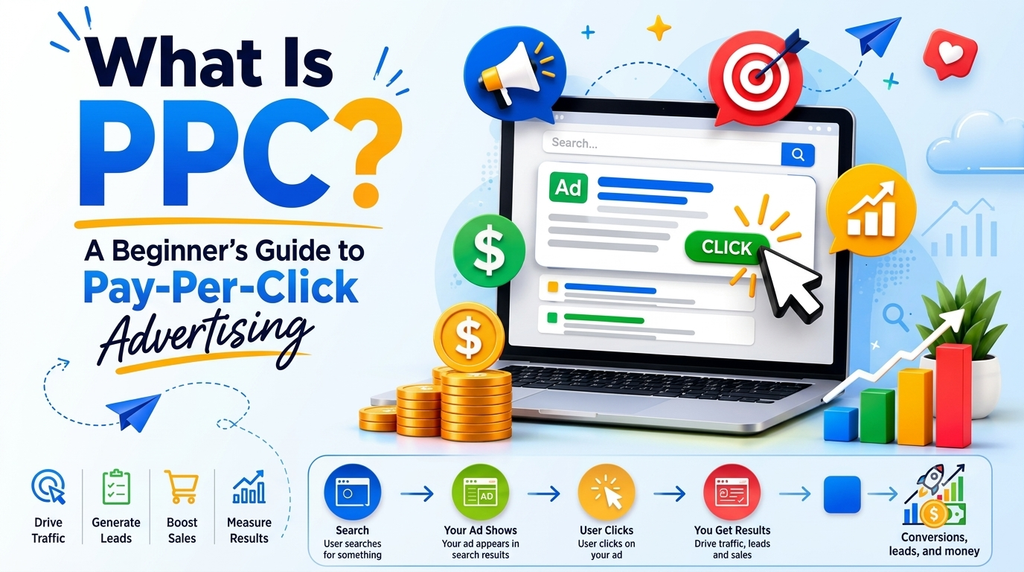
PPC stands for pay-per-click, a form of online advertising in which advertisers pay a fee each time someone clicks on their ad. Instead of waiting for visitors to discover your website through organic search, PPC allows you to place your business in front of people who are actively searching for a product, service, or solution.
For example, if you search for “best digital marketing agency near me,” the results marked as “Sponsored” or “Ad” are usually PPC advertisements. The business does not necessarily pay simply because the ad appeared. It typically pays when someone clicks the ad and visits its website or landing page.
PPC is used across search engines, social media platforms, websites, shopping platforms, and video networks. Google Ads is one of the best-known PPC platforms, but businesses also use Microsoft Advertising, Meta Ads, LinkedIn Ads, Amazon Ads, and other advertising networks.
How Does PPC Advertising Work?
A PPC campaign usually involves advertisers, advertising platforms, keywords, ad auctions, and landing pages.
Here is a simple example:
- A business creates an advertisement for its service.
- It chooses keywords or audience characteristics related to its target customers.
- A user searches for a relevant term or matches the selected audience criteria.
- The advertising platform decides which ads should appear.
- The user clicks the ad and visits the business website.
- The advertiser is charged for the click.
PPC platforms generally use an ad auction to determine which ads appear and in what order. Your bid matters, but it is not the only factor. Relevance, ad quality, expected click-through rate, landing page experience, and the usefulness of the advertisement can also influence placement.
This means a business with a smaller budget may sometimes compete successfully against a larger advertiser if its ad and landing page are more relevant.
Main Types of PPC Ads
PPC advertising includes several campaign formats. The right option depends on your business goals and target audience.
Search ads
Search ads appear on search engine results pages when users search for specific keywords. They are particularly useful for reaching people who already have a clear need or purchase intention.
A plumber, for instance, might target keywords such as “emergency plumber near me” or “leaking pipe repair.”
Display ads
Display ads appear on websites, mobile apps, and online content platforms. They normally include an image, headline, and call to action.
Display advertising is useful for building brand awareness, promoting offers, and reminding previous website visitors about your business.
Shopping ads
Shopping ads display products, prices, images, store names, and other details directly in search results. They are commonly used by e-commerce businesses that want to attract shoppers who are comparing products.
Social media ads
Platforms such as Instagram, Facebook, LinkedIn, and Pinterest allow businesses to run paid campaigns based on interests, demographics, online behaviour, location, or previous interactions.
Social media PPC can be helpful when people may not be actively searching for your product but are likely to be interested in it.
Video ads
Video PPC ads can appear on platforms such as YouTube and within other video content. They are useful for demonstrations, tutorials, product launches, testimonials, and storytelling.
Why Do Businesses Use PPC?
PPC offers several advantages when it is planned and managed carefully.
Fast visibility
SEO can take time to produce results. PPC can place your business in front of potential customers shortly after a campaign goes live.
Targeted traffic
You can target specific keywords, locations, devices, audiences, times, and demographics. This allows you to focus your budget on people who are more likely to become customers.
Measurable performance
PPC platforms provide data such as impressions, clicks, click-through rate, cost per click, conversions, and return on ad spend. This helps you understand what is working and where your budget is being spent.
Budget control
Most platforms allow you to set daily or campaign-level budgets. You can pause, adjust, or stop campaigns when necessary.
Useful testing opportunities
PPC allows you to test different headlines, offers, landing pages, keywords, and calls to action. These insights can also improve your website content and broader marketing strategy.
How Much Does PPC Cost?
There is no single fixed price for PPC advertising. The cost depends on factors such as:
- The competitiveness of your keywords.
- Your industry and location.
- The quality and relevance of your ads.
- Your campaign settings.
- The platform you use.
- The number of businesses competing for the same audience.
- Your landing page experience.
The amount you pay for a click is commonly called cost per click, or CPC. Some clicks may cost only a small amount, while competitive industries can have much higher CPCs.
A sensible starting point is to set a budget that allows you to collect enough data without risking money your business cannot afford to lose. Avoid choosing a budget simply because it is recommended by an advertising platform. First decide what a lead or sale is worth to your business.
For example, if you sell a product for ₹2,000 and your profit is ₹800, paying ₹100 for a click may be acceptable only if enough clicks eventually produce sales.
Important PPC Terms for Beginners
Understanding common PPC terms makes campaign reports easier to read.
- Impression: The number of times your ad is shown.
- Click: An interaction that sends a user to your website or chosen destination.
- CTR: Click-through rate, calculated by dividing clicks by impressions.
- CPC: The average amount paid for each click.
- Conversion: A valuable action, such as a purchase, enquiry, phone call, or form submission.
- Conversion rate: The percentage of visitors who complete a desired action.
- CPA: Cost per acquisition or action.
- ROAS: Return on ad spend, which compares revenue with advertising costs.
- Landing page: The page users reach after clicking your advertisement.
- Negative keyword: A term you exclude to prevent your ad from appearing for irrelevant searches.
How to Create Your First PPC Campaign
1. Define your objective
Choose one clear goal, such as generating leads, selling products, receiving phone calls, or increasing website visits. A campaign with a specific objective is easier to measure.
2. Identify your target audience
Decide who you want to reach. Consider their location, needs, budget, search habits, and stage in the buying journey.
3. Research relevant keywords
Select keywords that match what your potential customers may search for. Focus on terms with clear intent instead of choosing broad words that attract unrelated traffic.
4. Write useful ad copy
Your advertisement should explain what you offer and why someone should click. Include a relevant benefit and a clear call to action, such as “Book a Consultation” or “Shop Now.”
5. Create a relevant landing page
Do not send every visitor to your homepage. Create or select a page that matches the advertisement and makes the next step obvious.
6. Set up conversion tracking
Track meaningful actions before judging campaign performance. A click is useful, but a completed purchase, booking, or enquiry is usually more valuable.
7. Start with a controlled budget
Launch with a manageable budget and review results regularly. Do not make major changes after only a few hours of data.
8. Monitor and improve
Review search terms, conversions, costs, ad performance, and landing page behaviour. Remove irrelevant traffic, test new messaging, and invest more in campaigns that produce valuable results.
PPC Mistakes to Avoid
Beginners often make these mistakes:
- Choosing keywords that are too broad.
- Sending paid traffic to a slow or confusing page.
- Focusing on clicks instead of conversions.
- Ignoring negative keywords.
- Failing to install conversion tracking.
- Changing campaigns too frequently.
- Writing ads that make promises the landing page does not support.
- Spending money without knowing the value of a lead or sale.
Is PPC Worth It?
PPC can be worthwhile for businesses that want fast visibility, measurable traffic, and control over their advertising budget. However, it is not a magic solution. A campaign can waste money when the targeting is weak, the advertisement is unclear, or the landing page does not persuade visitors to take action.
The best results usually come from treating PPC as an ongoing process. Start with a clear goal, test carefully, track conversions, and improve your campaigns using real performance data.
Final Thoughts
PPC is a practical way to connect with potential customers at the moment they are searching, browsing, or showing interest in a product. Once you understand how targeting, bidding, ad quality, and conversion tracking work, paid advertising becomes much easier to manage.
You do not need a huge budget to begin. You need a focused objective, relevant keywords, helpful advertisements, and a landing page that delivers what the ad promised.